Short version: The best gift from a grandkid fits the giver's age, not the grandpa's bracket. A toddler gives a handprint, a child gives a photo, a teen saves for something real, and an adult gives something that says they know him. The price tag matters less than the match between the gift and the stage of life behind it.
We write buying guides, not reviews. We have not used every product on this page, and no grandfather has graded them for us. Specs come from the manufacturer or the listing, and whatever Amazon shows when you click is the authoritative figure.
This article contains affiliate links. If you buy through one, we earn a small commission at no extra cost to you. We only recommend what we would suggest to a friend.
The Federal Trade Commission's endorsement guides, 16 CFR Part 255, require a disclosure like that one to be difficult to miss, so it sits above every link here. Our full affiliate disclosure has the rest.
Written by the editorial team behind this site — gift researchers who compile buying guides from public sources, manufacturer specs, and customer reviews rather than hands-on product testing.
Most gift guides sort by the recipient. This one sorts by the giver, because a three-year-old and a thirty-year-old are not solving the same problem. The gifts for grandpa who says he doesn't need anything start from a different place when the giver can barely hold a crayon.
The numbers show how much room there is to get it right. The NRF's 2026 Father's Day survey projects record spending of $27.9 billion, up from $24 billion the year before. But only 7% of those shoppers are buying for a grandfather, versus 45% for a father or stepfather. Grandpa gets less of the budget and more of the afterthought, which is why the giver's effort matters more than the dollar amount.
We say grandpa here. Yours may be papaw, pop, pops, grandad, abuelo or opa, and your word is the right one.
The toddler grandkid: a handprint beats a store-bought mug
A toddler cannot shop. That is the gift.
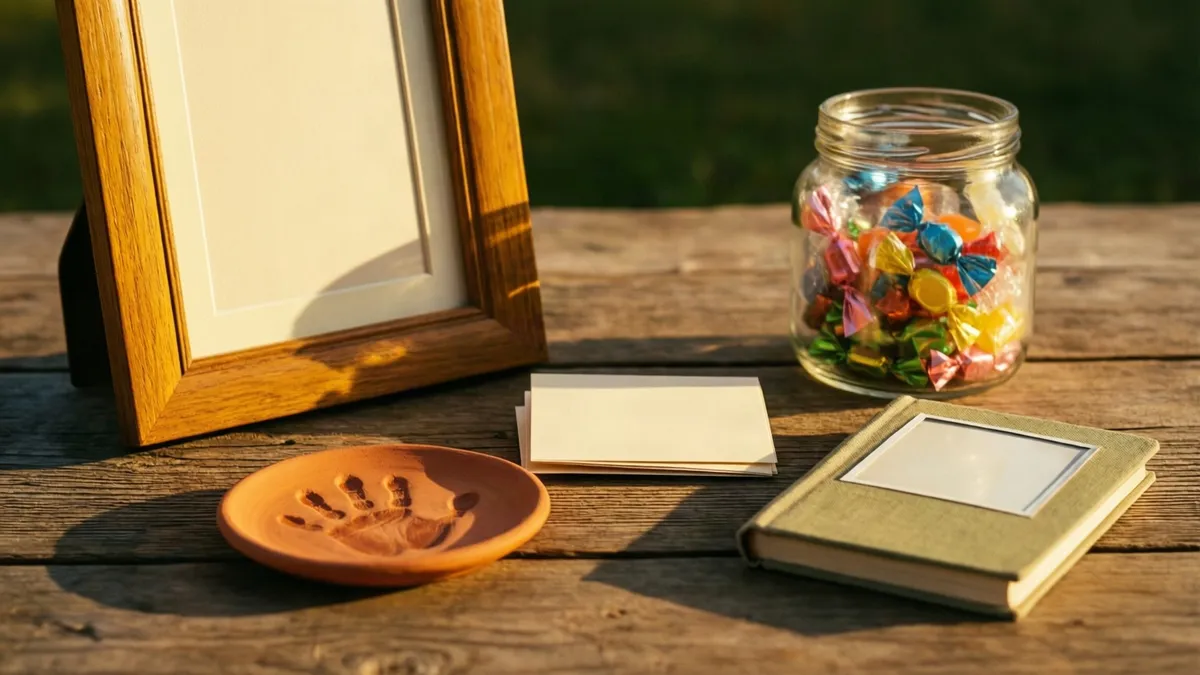
The youngest givers give presence, not products. A handprint in clay, a finger-painted card, a scribble on butcher paper. These are keepsakes because they capture a moment the giver will outgrow, and nobody can buy that at a store.
What you buy is the surface. A washable finger-paint kit and a pack of card stock cost under $15 and produce something that goes on the refrigerator, not in a drawer. The listing states the paints are non-toxic and washable, which matters more than any feature on a printed mug.
Skip the mug that says "World's Best Grandpa." A toddler's handprint on card stock is worth more to him than anything with a title printed on it, because one is the child and the other is a category. If you want something more durable, a handprint clay kit captures the shape and hardens into a keepsake.
The gift is the afternoon. The object is the receipt.
The elementary giver: crafts that hold up
Kids five to ten can make something that lasts.
With a little guidance, an elementary-age grandkid can produce a keepsake that does not look like a school project. A painted wooden frame with a photo inside. A coupon book of "one free hug" and "one afternoon of yard work." A decorated jar of his favorite candy. These hold up because the child chose the contents.
A blank wooden picture frame gives a child a surface to decorate and a reason to pick a photo. The coupon book costs nothing and teaches the kid that a gift can be a promise, which is a lesson worth learning before the first real paycheck arrives.
The photo matters here. A child who picks the photo is telling you what they remember about the man, and that is the gift. The frame is just the housing.
The teen grandkid: budget, not thoughtlessness
A teenager has a budget. That is not the same as having an excuse.
Consumers plan to spend $226.58 on average for Father's Day, the NRF reported in 2026, up from $199.38 the year before. A teenager is not spending that. A teenager is spending $15 to $40, and the gap between the average and the teen's budget is where effort has to do the work money cannot.
A custom photo book with twenty pictures from family events costs under $25 and takes an evening to assemble. The teen chose the photos, arranged them, and paid for the print with money they earned. That is a real gift, not a placeholder.
A personalized mug is fine at this age if the teen designs it. A custom photo mug with a picture the teen picked is different from a mug that says "Grandpa" on a warehouse shelf. One is a choice. The other is a category.
Per the NRF, online is the most popular Father's Day shopping destination at 38%, followed by department stores at 37% and discount stores at 26%. A teen shopping online with a fixed budget is already doing what most shoppers do. The constraint is not the money. The constraint is whether the teen treats the budget as a reason to think or a reason to settle.
The young adult giver: the first real paycheck
Eighteen to twenty-five is when the budget opens up and the thoughtfulness has to match.
The NRF's 2026 data shows 31% of consumers plan to give an experience for Father's Day, and 45% are interested in gifting a subscription box. Both are options a young adult can pull off, and both solve a different problem than the teen's photo book solves.
An experience does not have to be expensive. Tickets to a game, a dinner out, a Saturday fishing together. The young adult is buying time with him, not an object for him. If you live far away, a coffee subscription delivery sends something he uses up, which means it does not become clutter.
The young adult's advantage is knowing him as a person, not just as a grandpa. If he reads, a book he would not buy himself. If he listens to music, a turntable he would not justify on his own. The gift at this stage should reflect something the giver knows about the man, not something a gift guide told them about grandfathers.
If you are stuck, the best gifts for grandpa sorted by decade can help you match the gift to his era instead of his age.
The adult grandkid: the gift that says I know you
Twenty-six and up, the gift should carry the weight of the relationship.
An adult grandchild has known the man for decades, and the gift should show it. Greeting cards lead Father's Day gifts at 60%, the NRF found in its 2026 survey, followed by clothing at 58%, a special outing at 55%, and gift cards at 52%. Cards and outings top the list, which tells you the most given gifts are the ones that cost time, not just money.
A digital photo frame pre-loaded with family photos is a gift an adult grandchild can set up before it ships. That matters, because a gift that needs setting up is a gift that includes your time. If nobody will configure it, load it, and answer questions about it later, it is the wrong gift.
A legacy recording is the most valuable gift an adult can give, and it costs nothing but an afternoon. Record him talking about his life, his work, the decade he came up in. Use your phone. The recording is the gift, and it is the one thing nobody else can produce.
If he has everything, the gifts for grandpa who has everything come down to things that get used up. They could be things that hang on a wall, or an afternoon of your time. An adult grandchild can offer the afternoon.
What to write in the card, no matter the age
The note is part of the gift. Do not skip it.
A card with a printed poem and no signature is a wrapper, not a gift. Two lines in your own handwriting are worth more than a verse someone else wrote. The NRF's 60% card figure means most people are already giving cards, so the ones that matter are the ones with something written inside.
Here is a template you can copy and fill in:
Dear [his name], I picked this because [one specific thing about him]. The last time I remember us [specific shared moment], I felt [one word]. I am glad you are my grandpa. Love, [your name]
That is enough. One specific memory beats three sentences of gratitude that could apply to anyone. A toddler's card is a scribble. A teen's card is a photo and a line. An adult's card is a memory the grandpa forgot he gave.
When a grandkid has no budget and no idea
Two problems, one section.
If the budget is zero, the gift is time. A phone call on a Sunday, a visit on a Saturday, a letter mailed through the United States Postal Service with a stamp. These are free and they are the gifts he will remember. 77% of consumers plan to celebrate Father's Day in 2026, per the NRF's figures, and a phone call counts as celebrating.
If you do not know him well, ask a parent. Your mom or dad knows what he reads, what he watches, what he talks about at dinner. Use that. A gift chosen from a parent's tip is not a lazy gift. It is a gift that used the family as a resource.
If no one has a tip, go general but go specific within the general. A jigsaw puzzle of a place he has been is a general-interest gift that still points at his life. The worst gift is not a cheap one. The worst gift is a thoughtless one, and thoughtlessness is free to fix.
A quick comparison of grandkid gifts by age
Price bands below are ours, not a sourced figure.
| Giver's age | Example gift | Cost (our judgment) | Effort | What it communicates (our judgment) |
|---|---|---|---|---|
| Toddler (under 5) | Handprint in clay | Under $15 | Low for giver, guided by a parent | "I was here, and I am this small right now" |
| Elementary (5 to 10) | Painted frame with a chosen photo | $10 to $25 | Medium, with guidance | "I picked this photo because I remember this day" |
| Teen (11 to 17) | Photo book from their phone | $15 to $40 | Medium, all their own | "I saved for this and I chose every page" |
| Young adult (18 to 25) | Tickets to a game or a coffee subscription | $50 to $100 | Low to medium | "I know what you like and I can afford to show it" |
| Adult (26 and up) | A legacy recording or a trip together | $0 to $200+ | High, and that is the point | "I know you, and I want to keep knowing you" |
Our take: The pattern is simple: the older the giver, the more the gift should sound like a sentence only they could write. A toddler's handprint is the best gift in the lineup not because it is the most thoughtful but because it is the most honest. An adult's legacy recording is the most valuable not because it costs the most but because it is the one thing nobody else can produce. If you are choosing between spending more and thinking more, think more. The NRF puts the average Father's Day spend at $226.58, and a handwritten letter beats a $226 gift bought in a hurry.
Questions about gifts for grandpa from grandkids
What gifts can a toddler or young child make for grandpa?
A handprint in clay, a finger-painted card, or a scribble on butcher paper. The child does not need to produce anything recognizable, because what matters is that the object captures the child at a size and stage they will outgrow by next year. A parent's job is to provide the materials and get out of the way.
What gifts can a teenager afford to buy for grandpa?
A teenager working with $15 to $40 can print a photo book, design a custom mug, or buy something small that reflects a shared interest. The budget is real but not the constraint. The constraint is whether the teen treats the budget as a reason to think or as an excuse to grab the first thing under $20 at the checkout.
What are some free or no-cost gifts from grandkids?
A phone call, a visit, or a handwritten letter mailed through the USPS. A legacy recording made on a phone, where the grandpa talks and the grandchild asks questions, costs nothing and becomes the most valuable thing in the house. Free does not mean thoughtless, and a letter in a shoebox outlasts a gift card in a drawer.
How much should a grandchild spend on a gift for grandpa?
There is no rule, but the NRF's 2026 survey puts the average Father's Day spend at $226.58, and a grandchild does not need to approach that number. A toddler spends nothing, a teen might spend $25, and an adult might spend $100 or more. The match between the gift and the giver's stage matters more than the dollar amount.
What should I write in a card or note to go with the gift?
One specific memory and one sentence about why you chose the gift. Avoid printed poems and generic gratitude. A card that says "I remember when you taught me to cast a line at the lake, and I still go" is worth more. It is worth more than a card that says "Thank you for being a wonderful grandfather." The first one could only come from you.
How do I choose a gift for a grandpa I don't know well?
Ask a parent first. Your mom or dad knows what he reads, what he watches, and what he mentions at dinner. If no one has a tip, choose a general-interest gift that still points at his life. This could be a puzzle of a place he has visited or a book on a subject he brings up. General does not have to mean generic.
Katie Doyle writes buying guides, not reviews; nothing here was tested by us.
Sources
- National Retail Federation — "Father's Day Spending to Hit Record $27.9 Billion" (https://nrf.com/media-center/press-releases/father-s-day-spending-to-hit-record-27-9-billion) Retrieved 2026-08-23.
- Federal Trade Commission — "Guides Concerning the Use of Endorsements and Testimonials in Advertising" (https://www.ftc.gov/legal-library/browse/federal-register-notices/guides-concerning-use-endorsements-testimonials-advertising) Retrieved 2026-08-23.